
In this month’s blog I wanted to write about the value premium, which is something instrumental in the investment philosophy we adhere to here at Claris Advisors. But I ran across an article from our partners Dimensional Fund Advisors (DFA) that would do better justice to the subject than I could. Also, DFA just happens to be where this investment philosophy started and continues today. So, enjoy this article:
Historically, value stocks have outperformed growth stocks in the US, often by a striking amount. Data covering nearly a century backs up the notion that value stocks—those with lower relative prices—have higher expected returns.
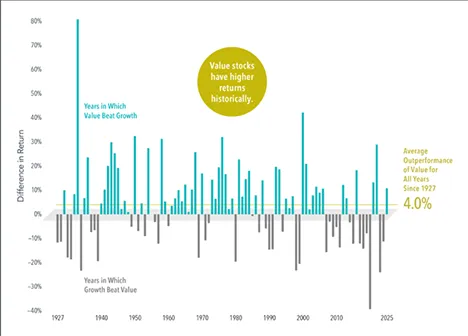
While disappointing periods emerge from time to time, the principle that lower relative prices lead to higher expected returns remains the same. Value premiums have often shown up quickly and in large magnitudes. For example, in years when value outperformed growth, the average premium was nearly 15%. On average, value stocks have outperformed growth stocks by 4.0% annually in the US since 1927, as Exhibit 1 shows.
EXHIBIT 1
Value Add
Yearly observations of premiums: value minus growth in US markets, 1927–2025
Past performance is no guarantee of future results. Investing risks include loss of principal and fluctuating value. There is no guarantee an investment strategy will be successful.
The Fama/French indices represent academic concepts that may be used in portfolio construction and are not available for direct investment or for use as a benchmark. Index returns are not representative of actual portfolios and do not reflect costs and fees associated with an actual investment.
A consistent focus on value stocks is essential to capturing these outsize value premiums when they appear. Value investing is based on the premise that paying less for a set of future cash flows is associated with a higher expected return. That’s one of the most fundamental tenets of investing. Logic and history support a commitment to value stocks so investors can be positioned to take part when those shares outperform in the future.